

Overview
A Departmental Action Team (DAT) is a working group of four to eight faculty, staff, and students created by the department (and guided by an external facilitator from TLL) to achieve the following goals:
- Create sustainable change around a broad-scale issue related to undergraduate education, with the focal issue developed collaboratively with input from relevant departmental stakeholders.
- Collect multiple forms of evidence to inform decision-making about the focal issue.
- Recognize and adapt departmental structures and culture to achieve positive and meaningful change in undergraduate education.
- Explicitly attend to long-term sustainability when making changes in the department.
A core feature of the DAT is that the working group (and other relevant stakeholders) collaboratively develop the focus of the project to improve undergraduate education.
Examples of focal issues addressed by DATs include
- Changes to the curriculum (e.g., restructuring a course sequence).
- Pedagogy (e.g., increasing collaborative learning or broadening student participation in class)
- Culture (e.g., building a sense of belonging among students).
Staff in the TLL will bring their expertise in educational research, evidence-based teaching, and organizational change to facilitate working groups and create an environment where DAT participants are likely to succeed.
DATs support their participants not only in making meaningful, positive change within their departments, but also in developing the capacity to sustain the project and continue leading change in the future.
Drs. Ruthann Thomas and Raechel Soicher lead this initiative. You may read more about the value, goals, process, time commitment, and concrete examples of DATs in the Frequently Asked Questions section below. Reach out to tll-dat@mit.edu with any questions.
January Webinar on DATs
In January 2026, Drs. Ruthann Thomas and Raechel Soicher provided a brief overview of the goals, structure, and process for creating and sustaining Departmental Action Teams (DATs) to identify and implement curricular and/or pedagogical changes that improve undergraduate education.
View recording on Panopto (restricted to the MIT Community).
Frequently Asked Questions
What are some concrete examples of DATs?
The three examples illustrate the possible focus and outcomes, as well as the structure of the Departmental Action Team’s membership. These examples highlight the variety and scope of the focal issues addressed in DATs, as well as the aligned outcomes and the diverse membership across relevant department roles.
Example A – Generative AI
- Focus: Consider the use (and implications for student learning) of generative AI in student work across the department; consider discipline-appropriate AI-use policies.
- Membership:
- 2 tenure-track faculty
- 2 instructors
- 2 graduate students
- 2 undergraduate students
- Outcomes:
- Collect a searchable database with examples of assignments that measure/support a variety of learning outcomes subject to the constraints of acceptable AI-use policies (including examples/ explanation of how the assignment was adapted to be AI-aware)
- Conduct a survey or focus groups with students to identify how students feel about their learning and if/how they are using generative AI
- Develop departmental guidelines and/or policies on the use of generative AI
Example B – Student Skills Assessment
- Focus: Assessing majors’ disciplinary skills
- Membership:
- 7 tenure-track faculty,
- 4 graduate students,
- 1 undergraduate student
- Outcomes:
- Development of a long-term assessment plan
- Development and piloting of a skills assessment
- Departmental approval for two faculty members to implement a multi-year skills assessment
Example C – Community & Belonging
- Focus: Engaging undergraduates in the departmental community
- Membership:
- 2 tenure-track faculty
- 2 instructors
- 2 graduate students
- 2 undergraduate students
- Outcomes:
- Welcome events for new and prospective majors
- Establishment of departmental social media presence
- Creation of an annual Industry Night
- Improvements in ways to involve undergraduates in departmental committees
What does the work of a DAT look like?
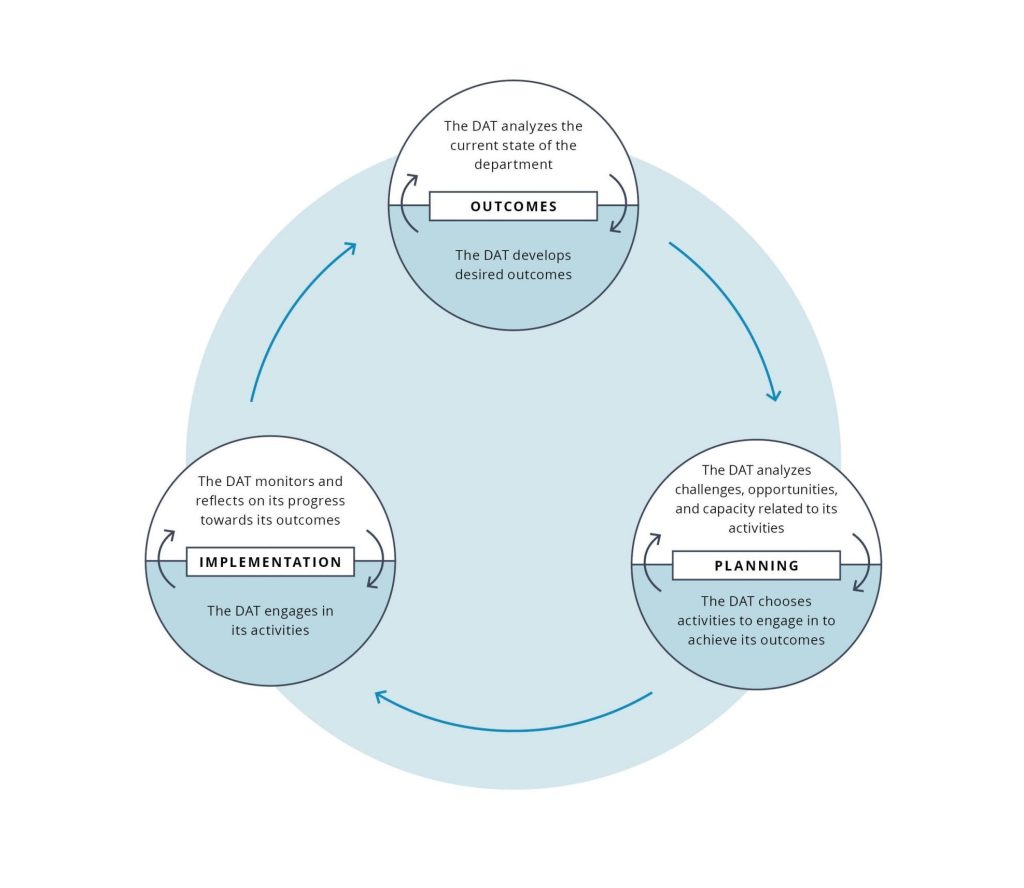
At a high level, the DAT analyzes the department’s current state relative to the selected focus and defines desired outcomes. Based on initial and subsequent analyses, the DAT selects activities to help achieve the outcomes. As the DAT engages in those activities, it monitors and reflects on the progress made toward those outcomes.
image
The detailed outline below is one concrete example of the various steps of a DAT; however, because the model is rooted in a collaborative process with the department, these steps may be adapted according to departmental needs, resources, etc.
Step 1: Recruit members to the DAT
Department meeting presentation to recruit participants
DAT Membership
Year 1: two tenured faculty members, two pre-tenure faculty members, and one postdoc
Year 2 +: expanded to include two staff members, three graduate students, and two undergraduate students.
Step 2: Decide on a focus for the DAT
- The underrepresentation of women and students of color their area of focus (a STEM department)
Step 3: Set goal(s) for the upcoming year
- Collect and analyze data on attrition and representation among the department’s undergraduates, enabling it to quantify weaknesses in recruitment and retention of women and URM students.
Step 4: Meet bi-weekly for the entire academic year (15, 1-hour meetings)
- Designed and administered a climate survey for majors graduating that December and a survey of help room use among students in the department’s large introductory courses.
- Acquired a dataset from the university’s Institutional Research office that included demographic and academic information on all department applicants and majors over the last decade.
- Analyzed the collected data and reported their findings to the group over several meetings.
- Created a two-page summary of their findings and a list of recommendations to present at a faculty meeting.
Step 5: Make recommendations to the department
- The DAT recommended creating a new departmental Committee on Representation, Recruitment, and Retention (R3) charged with learning about and acting on the underrepresentation of marginalized groups among the department’s undergraduates.
Step 6: Repeat this process, starting with Step 3, for year 2 with a new goal
Goal: Implement specific changes within the department to address the underrepresentation of certain groups of undergraduate students in the department
The Changes:
- Contacting admitted students.
- Following an analysis of admissions data, the DAT decided to launch a new recruitment initiative.
- Partnering with the university’s strategic relations (SR) office to improve advertising for the department.
- SR will work with the IC to redesign the department’s website and other promotional materials to better reflect the opportunities the department provides for women and URM students and to make information about navigating the university easier to access
- Working with the department’s building manager to do a survey of the bathrooms in the building in order to designate some bathrooms as gender-neutral.
Next Steps / Sustainability
- The DAT has planned several activities to address community and culture within the department longer-term.
- The coming academic year will begin with an undergraduate welcome event hosted by the DAT.
- One of their goals will be to normalize conversations about inclusion across the department.
- Monthly meetings open to all department members will be held to maintain the conversations started during the DAT process. One of their goals will be to normalize conversations about inclusion across the department.
- The DAT plans to augment the current undergraduate advising process by partnering with a student-led mentoring program to provide its undergraduate mentees with faculty mentors.
What is the time commitment for DAT members?
In a typical academic year, the DATs are likely to meet once every 2-3 weeks for 60 – 90 minutes. Each DAT member is likely to spend 2-4 hours per month of DAT work (including meeting time) throughout the academic year. The timing and frequency of these meetings will be decided by the DAT as a group, with the goal of meeting often enough to support meaningful change and to foster a productive and rewarding collaboration.
How does the Departmental Action Team develop the focus of its work?
A Departmental Action Team (DAT) is a team of faculty members, students, and/or staff that makes sustainable change by designing and implementing departmental structures and influencing culture to address an educational issue of broad-scale importance. We refer to this educational issue as the focus of the DAT project.
Once the team is assembled, the DAT will develop a shared vision of what undergraduate education should look like in the department, supported by TLL facilitators and activities designed to hone in on the interests and values of DAT members. Next, the DATs will set goals: specific outcomes that demonstrate progress toward the shared vision. Then, the DAT will take actions to achieve specific goals. The visioning and goal setting are derived from a combination of the DAT’s values and interests along with collaborative decision-making among the DAT members.
What is the role of the Teaching + Learning Lab in the DAT?
The role of the Teaching + Learning Lab is supportive: TLL staff will bring expertise in pedagogy, educational development, and organizational change to guide the process, rather than the focus, of the DAT project. The TLL staff are not DAT members; they are facilitators who provide support tailored to the DAT’s needs, interests, and goals. TLL facilitators will help the group cultivate a collaborative environment to carry out its work and manage the logistics for DAT meetings. By having facilitators positioned outside the departments’ community and culture, TLL staff can also ask questions that help DAT members explore the underlying assumptions about teaching and learning in their department.
What is the value in using the DAT model?
The DAT model is an alternative approach to effecting change in an academic department, grounded in scholarly literature on organizational change that identifies academic units as key drivers of change (Reinholz & Apkarian, 2018; Ngai et al., 2020).
Several characteristics make the DAT model valuable:
- The scope of changes goes beyond single courses or one or a few instructors to influence the department as a whole.
- Explicit attention to thinking through and planning for change enables more sustainable change.
- Department members can continue to make changes even after the initial goals have been achieved.
- The model’s flexibility allows for adaptation to the departmental context, increasing the likelihood of sustained success.
Several core principles inform the work of the DAT. The DAT is:
- Guided by outcomes of a shared, long-term vision to create sustainable change
- Characterized by productive and rewarding collaboration among relevant stakeholders in the department, including students
- Grounded in analysis of multiple relevant forms of data, iteration, and continuous improvement
See Quan et al. (2019) for more on principles for supporting sustained change efforts at the department level.
What does a Stage I project proposal look like?
The Call for Preliminary Proposals for the Alex and Brit d’Arbeloff Fund for Excellence in Education involves a brief (no more than 2 pages, PDF format) high-level preliminary proposal outlining the proposed work, rationale, opportunities and risks, resources needed and some ideas for assessment.
Given that the focus of the DAT project will be developed collaboratively in the early stages of the project, we’ve provided guidance below on what to include in the proposed work and rationale sections of a preliminary proposal:
Proposed work should include:
- A brief description of any former efforts in the department (formal or informal) focused on undergraduate education, and
- One or more educational issues of broad-scale importance that you think could inform the focus of a DAT in your department. Keep in mind that the DAT members will develop the focus after forming initial ideas about the composition of the members of the Department Action Team (e.g., faculty, staff, and students)
Rationale:
- Briefly discuss why you think a DAT project would be a good fit for your department. Here, consider the core principles and value of the DAT as well as interest and support from the department head and other members of the department.
References
Ngai, C., Corbo, J. C., Falkenberg, K., Geanious, C., Pawlak, A., Pilgrim, M. E., Quan, G. M., Reinholz, D. L., Smith, C., & Wise, S. B. (2020). Facilitating Change in Higher Education: The Departmental Action Team Model. Glitter Cannon Press.
Quan, G. M., Corbo, J. C., Finkelstein, N. D., Pawlak, A., Falkenberg, K., Geanious, C., Ngai, C., Smith, C., Wise, S., Pilgrim, M. E., & Reinholz, D. L. (2019). Designing for institutional transformation: Six principles for department-level interventions. Physical Review—Physics Education Research, 15(1), 010141. https://doi.org/10.1103/PhysRevPhysEducRes.15.010141
