

What Happens in the Classroom is the Main Event
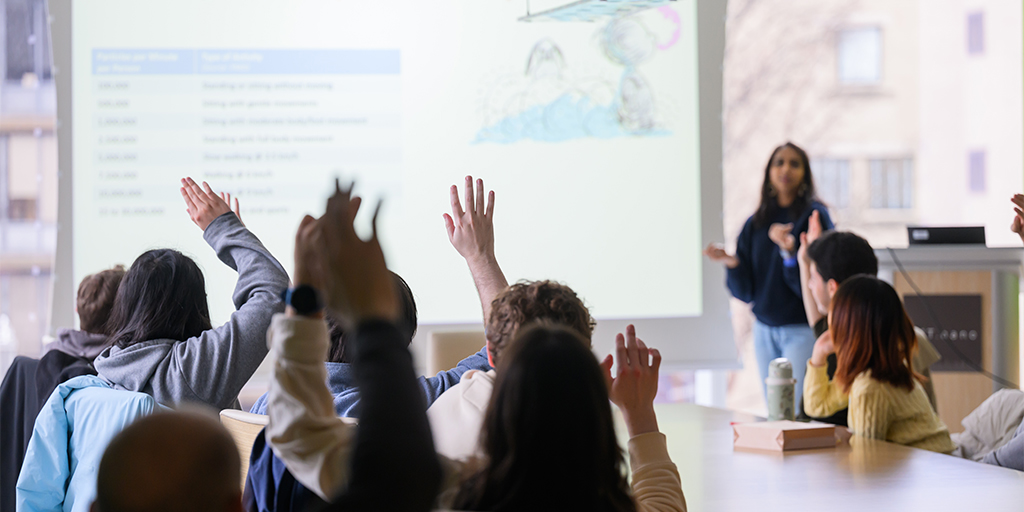
On Tuesday, February 24, 2026, TLL hosted Dr. Carlo Rotella, Professor of English, American Studies, and Journalism at Boston College, to discuss how he makes the time he spends with students in his classroom central to their learning and growth.
“Everything else about a college class–reading the books, being lectured to, having strong opinions that you fire off into the anonymous void–they can do at home in their underwear for free. We can all sit passively and be lectured at nonstop on YouTube, Instagram, TikTok, and whatever. What’s most rare, precious, and valuable about college classes is engaging with fellow citizens of a community of inquiry who give us attention and to whom we owe our attention.”
-Dr. Carlo Rotella, TLL Speaker Series, February 24, 2026
Dr. Carlo Rotella argues that the 2000 minutes spent together in the classroom are the main event. That is, the central focus of students’ learning and growth—especially as technology, from the internet to generative AI—has made face-to-face learning increasingly rare and valuable. He notes that students may never again spend 150 minutes a week engaging deeply with one another in person.
Rotella then outlined the teaching practices he uses, drawing on research from his latest book, What Can I Get Out of This: Teaching and Learning in a Classroom Full of Skeptics, as well as interviews he conducted with English teachers for a New York Times Magazine essay. As a professor of English, American Studies, and Journalism, he acknowledges that his approach may not fit every situation but suggests it can be applied broadly—even if only in part—across fields and disciplines.
Building on this view, Rotella argues against transactional thinking in college, which he sees as the enemy of learning. He notes that students and teachers often focus on exams, papers, and grades rather than classroom experiences as the central component of a course. Rotella’s classroom model resembles a team or band practice—students build individual skills while working collectively as a community of inquiry that defines and solves problems together. He employs two foundational policies that encourage a team practice environment: (1) No screens and (2) Everybody talks.
Rotella explained that devices with screens (phones, tablets, e-readers, or laptops) are not allowed in his classes and that students must always bring a hard copy of the reading. Rotella notes that devices with screens are inherently distracting and kill community building. Keeping them outside of class ensures that students’ attention stays in the present and increases engagement with both the subject at hand and one another.
The second principle, everybody talks, means that there are no silent partners–students must speak at least once per class session to be “good citizens” of the class community. Contributing to the discussion, Rotella contends, is the minimum requirement for classroom citizenship. As the team model implies, he sees his role as that of a coach. For students who are reluctant to speak up in class, he reaches out to them individually to discuss strategies to help them feel comfortable, which may include access to discussion questions, opportunities to rehearse their responses, and choice of seating. During class, Rotella facilitates the discussion by responding to students’ ideas, using “if/then” statements to connect their ideas, and avoiding “but” in favor of “and” to model the synthesis of ideas and the collective building of understanding. He also encourages students to chat with each other before class and to address one another by name.
Rotella’s principles and policies have led to what he calls an AI-resistant course design. He does not formally ban it, but students are asked not to use it—and are given a clear explanation of why the cognitive labor they would skip is exactly what they are there to develop. He compares using AI to save time reading for an English course to using an electric scooter at track practice—you complete the laps, but it doesn’t make you faster or stronger
To ensure students do their own thinking (and not use AI to short-circuit their learning), Rotella has brought back in-class blue books and oral exams (which takes a significant part of the load of assessment off out-of-class papers) that test students’ interpretive skills based on what is discussed in class. Quizzes are used to check whether students have completed the reading before class. Unlike traditional exams, they reward attentive reading by asking for granular details rather than general themes. For example, asking about the character’s laugh or his apartment renders AI summaries less helpful. His assignments focus on the writing process and are highly scaffolded. They include drafts, conferences, and peer reviews, making it more difficult to outsource to AI. He also recognizes that these strategies will inevitably need to be revised as AI continues to evolve.
Rotella stressed that building community is more important now than ever, not just to counteract “crude transactionalism” by giving students better reasons to show up to class, but because it offers shared purpose and belonging that combats loneliness and anxiety, making the 2,000 minutes not just an academic exercise but a rich and meaningful experience for students.
